The burpee, a dynamic full-body exercise, combines elements of cardio, strength training, and core engagement. Originating as a physical fitness test, its popularity has soared due to its effectiveness in improving overall fitness. This comprehensive guide delves into the nuances of proper burpee technique, highlighting crucial form, variations, safety considerations, and training progressions to help you master this versatile exercise safely and effectively.
This guide breaks down the burpee into manageable steps, from understanding the fundamental movements to mastering advanced variations. We’ll explore the benefits and potential risks, along with essential warm-up and cool-down routines to optimize your workout and minimize the risk of injury. Furthermore, we’ll provide modifications for various fitness levels and address common mistakes to ensure you execute the burpee with precision and confidence.
Introduction to Burpees
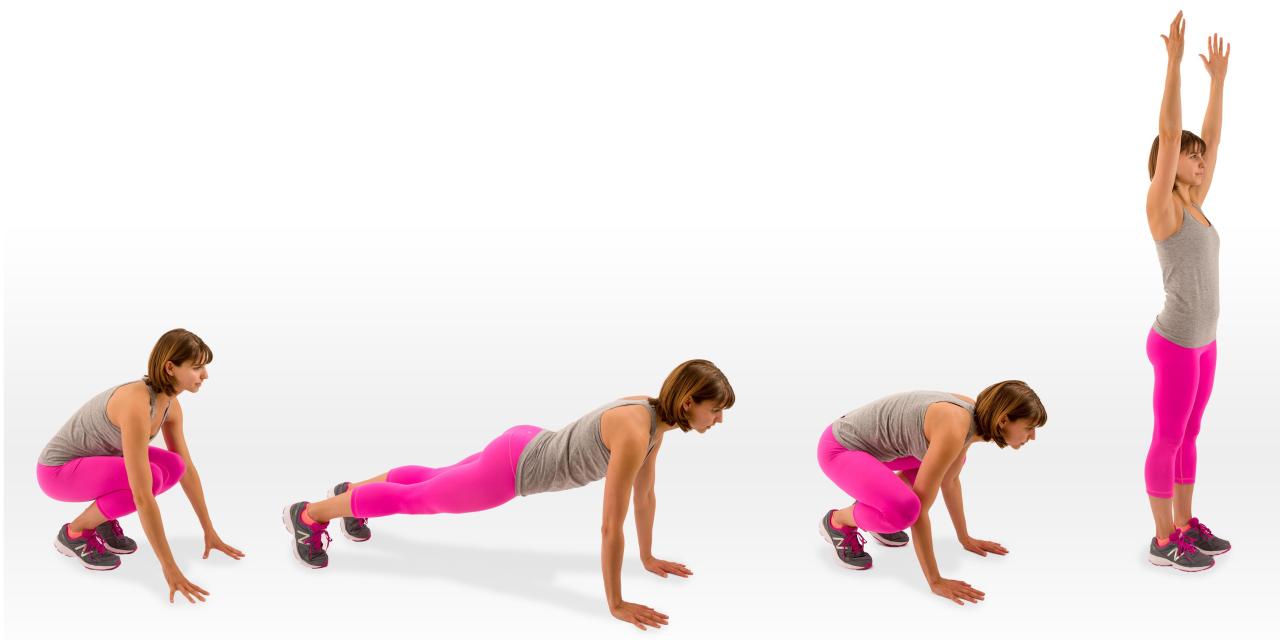
The burpee is a full-body exercise, combining elements of a squat, push-up, and jump. Its purpose is to provide a comprehensive workout, targeting multiple muscle groups and improving cardiovascular fitness. Its origins are somewhat obscure, but it’s likely a combination of different exercises, with its current form evolving over time, gaining popularity in the 20th century. While the exact inventor is unknown, the burpee has become a staple in fitness routines worldwide.Proper burpee form is crucial for maximizing effectiveness and minimizing risk of injury.
This involves a controlled and deliberate execution of each component, ensuring that the exercise engages the target muscles while maintaining proper alignment and balance. A correct form ensures the exercise targets the muscles intended and prevents potential injuries by minimizing stress on joints.
Key Components of a Burpee
The burpee involves a series of movements, each playing a critical role in its overall effectiveness. The key components are a squat, a push-up, and a jump. Maintaining proper posture and controlled movements throughout the exercise are essential for maximizing the workout’s effectiveness and minimizing the risk of injury.
Benefits of Burpees
Burpees are a highly effective exercise for building strength, improving cardiovascular health, and enhancing overall fitness. They are beneficial because they work multiple muscle groups simultaneously, leading to greater calorie expenditure and improved endurance. The exercise is suitable for a wide range of fitness levels, from beginners to advanced athletes.
Basic Burpee Steps
Understanding the individual steps is essential to perform a burpee correctly. This section Artikels the basic steps involved in executing a burpee.
| Step | Description |
|---|---|
| 1 | From a standing position, lower your body into a squat position, placing your hands on the floor just outside of your feet. |
| 2 | Quickly move your feet back into a plank position. Ensure your body forms a straight line from head to heels. |
| 3 | Perform a push-up, lowering your chest to the floor, then returning to the plank position. |
| 4 | Bring your feet back to your hands, returning to the squat position. |
| 5 | Explosively jump upwards, raising your arms above your head. |
Proper Form and Technique
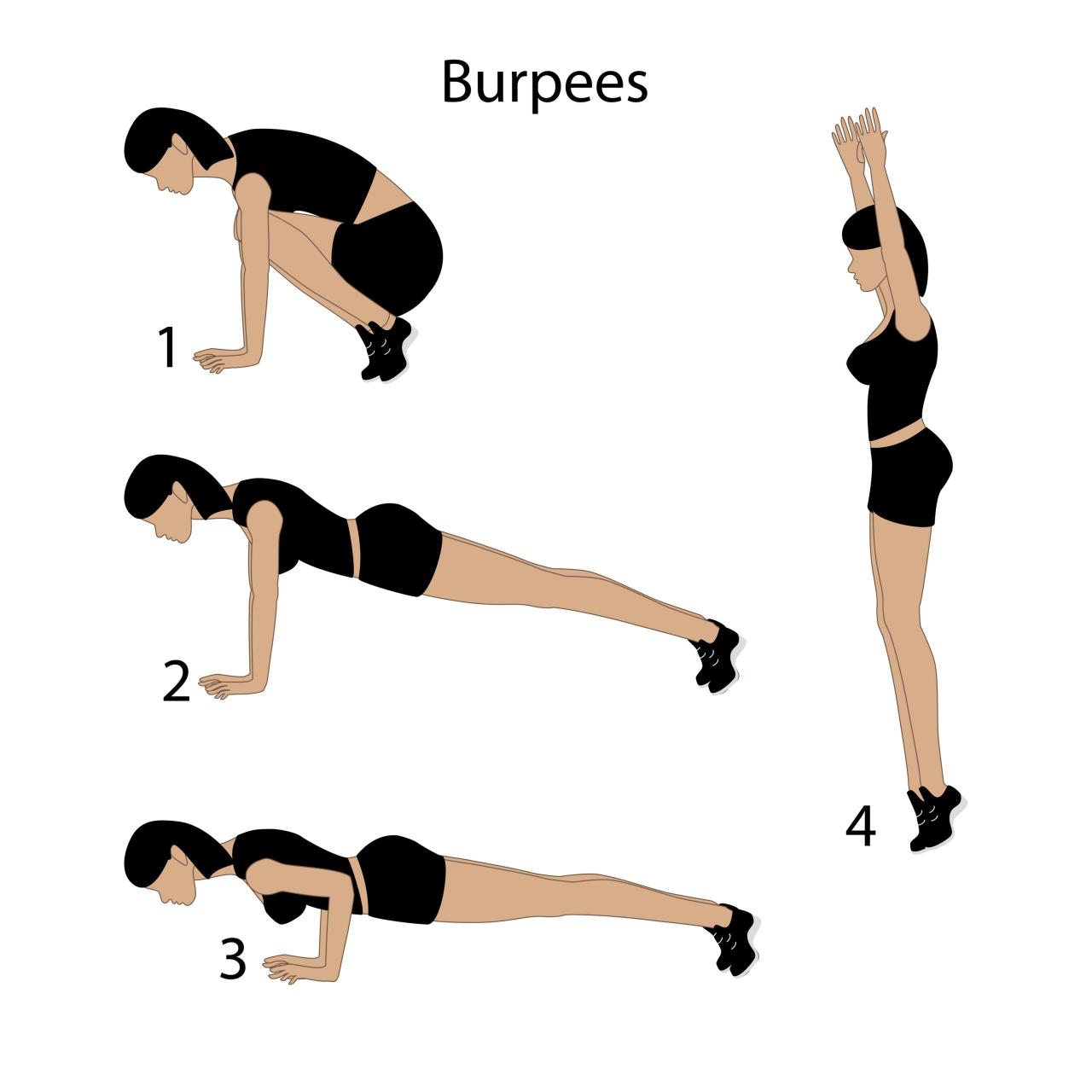
Executing burpees with proper form is crucial for maximizing their effectiveness and minimizing the risk of injury. A correct technique ensures the exercise targets the intended muscles and prevents strain on joints. Maintaining proper posture throughout the movement is paramount for achieving optimal results.Understanding and consistently practicing the proper form for each phase of the burpee is essential for efficient muscle engagement and injury prevention.
This involves precise movements and mindful attention to posture and positioning at every stage.
Maintaining a Straight Back
Maintaining a neutral spine throughout the entire burpee is essential for safety and effectiveness. A straight back supports the natural curvature of the spine, reducing stress on the lower back and promoting proper core engagement. This also helps maintain balance and control during the movement. This straight back position minimizes strain on the lower back and promotes optimal core activation, thereby enhancing the exercise’s efficacy.
Engaging Core Muscles
Engaging the core muscles throughout the exercise is vital for stability and power. A strong core acts as a foundation, supporting the body during the various phases of the burpee. Proper core engagement contributes to better posture, more controlled movements, and increased efficiency in the exercise.
Phase-by-Phase Execution
Proper posture and positioning are crucial for each phase of the burpee. Maintaining a consistent form throughout the exercise is essential for achieving optimal results and minimizing the risk of injury.
| Phase | Action | Body Position | Key Considerations |
|---|---|---|---|
| 1. Starting Position | Standing with feet shoulder-width apart. | Feet shoulder-width apart, arms relaxed at sides, back straight. | Maintain a stable, neutral spine. |
| 2. Squat and Hands Placement | Lower into a squat position, placing hands on the floor shoulder-width apart, slightly in front of the feet. | Body positioned in a squat, hands on the floor shoulder-width apart. | Keep the back straight, core engaged, and shoulders directly over the hands. |
| 3. Push-Up Position | Extend legs back into a plank position, performing a push-up. | Body in a straight line from head to heels, hands shoulder-width apart. | Maintain a straight line from head to heels. Hands directly beneath shoulders. |
| 4. Jumping to Starting Position | Bring the feet back to the hands. Jump upwards, bringing arms overhead. | Feet close to hands, arms raised overhead. | Ensure a controlled jump. |
| 5. Landing | Land softly on feet with knees slightly bent, back straight. | Feet shoulder-width apart, knees slightly bent, back straight. | Absorb the impact with knees, avoiding jarring landings. |
Hand Placement and Foot Placement
Proper hand placement during the push-up portion of the burpee is crucial for maintaining a straight line from head to heels. Hands should be positioned directly beneath the shoulders, ensuring a stable and controlled push-up. Foot placement in the push-up position also plays a role. Feet should be extended straight back behind the hands to maintain a straight line from head to heels.
Landing Technique
Landing after the jump is critical to prevent injury. A controlled landing, with knees slightly bent, absorbs the impact of the jump, preventing jarring and potential strain on the joints. A proper landing technique involves a soft touch with feet, and a gradual bending of knees to cushion the impact. This controlled landing minimizes the risk of injury and promotes a smoother transition back to the starting position.
Variations and Modifications
The burpee, while a powerful full-body exercise, can be adapted to suit various fitness levels and physical limitations. Understanding these variations and modifications is crucial for safe and effective exercise, ensuring optimal results without compromising form or risking injury.
Burpee Variations for Different Fitness Levels
Different modifications allow individuals to gradually progress towards the full burpee, enhancing their fitness journey. Beginners can adapt the burpee to suit their capabilities, ensuring they are performing the exercise safely and effectively.
- Modified Burpee (Beginner): In this variation, the jump is omitted, and the squat is performed on the floor. The push-up is either omitted or performed on the knees. This version provides a lower impact alternative while engaging the major muscle groups.
- Chair Burpee: This variation replaces the push-up with a dip on a chair or bench. This variation targets the chest and shoulder muscles while reducing the impact on the joints.
- Burpee with Elevated Push-up: Instead of a standard push-up on the ground, the individual performs the push-up on an elevated surface, such as a bench or a sturdy box. This modification makes the exercise less demanding on the wrists and shoulders.
- Burpee with a Reduced Squat Depth: Individuals can reduce the depth of the squat to minimize stress on the knees. The goal is to maintain proper posture and avoid excessive strain on the joints.
Modifications for Individuals with Limitations or Injuries
Adapting the burpee is crucial for individuals with specific physical limitations or injuries. Proper modification prevents aggravation of existing conditions and ensures a safe workout.
- Knee Problems: A modified squat, avoiding a deep knee bend, and using a chair or elevated surface for the push-up or a wall push-up, is a good alternative. Using a resistance band to support the legs can reduce knee strain during the burpee movement.
- Shoulder Problems: Avoid full push-ups and focus on exercises like a wall push-up or a modified push-up on the knees. The chest and shoulder muscles should be engaged, but the exercise should be modified to minimize shoulder impingement.
- Back Problems: The individual should avoid rounding the back during the squat and push-up phases. A less-intense exercise, like a chair burpee, is a good option. Additionally, a resistance band to support the core can help with back support.
Alternatives to the Traditional Burpee
While the burpee is effective, other exercises can offer similar benefits. These alternatives can cater to specific needs and preferences.
- Mountain Climbers: This exercise effectively targets the core, legs, and shoulders. It involves bringing the knees toward the chest in a dynamic motion, providing a cardio-focused alternative.
- Jumping Jacks: A simple yet effective cardio exercise that works several muscle groups. It targets the legs and core.
- Burpees with a Plank Pause: In this variation, the plank position is held for a few seconds before continuing to the rest of the burpee movement. This emphasizes core engagement.
Modifications for Specific Issues
This section provides a table summarizing modifications for individuals with knee, shoulder, and back problems.
| Problem | Modification | Explanation |
|---|---|---|
| Knee Problems | Modified Squat, Wall Push-ups, Resistance Band Support | Minimizes stress on the knees during the squat and push-up phases. |
| Shoulder Problems | Wall Push-ups, Modified Push-ups on Knees, Avoiding Full Range of Motion | Reduces the stress on the shoulder joints and prevents impingement. |
| Back Problems | Avoid rounding the back, Chair Burpee, Core Support with Resistance Band | Preserves spinal alignment and reduces stress on the back muscles. |
Benefits and Considerations
The burpee, a full-body exercise, offers a multitude of physical and mental advantages. However, like any intense workout, it’s crucial to understand its potential risks and implement proper precautions to maximize its benefits and minimize any potential harm. This section will delve into the advantages and disadvantages of incorporating burpees into your fitness routine, alongside essential considerations for safety and effectiveness.Proper warm-up and cool-down routines are essential to prepare the body for the exertion and facilitate recovery afterward.
This section will further explore the significance of these preparatory and post-exercise phases. Additionally, this section will detail the optimal intensity and frequency for different fitness goals, and will compare burpees to other exercises with similar objectives.
Physical Benefits of Burpees
Burpees are a highly effective exercise for improving cardiovascular health, strength, and endurance. They engage multiple muscle groups simultaneously, leading to significant calorie expenditure and overall fitness enhancement. The dynamic nature of the exercise contributes to increased heart rate, improved blood circulation, and enhanced lung capacity. Furthermore, the compound movements build strength in the legs, core, and upper body, potentially aiding in improved posture and overall body composition.
Mental Benefits of Burpees
Beyond the physical benefits, burpees can also positively influence mental well-being. The physical exertion and focus required can be a powerful stress reliever, promoting a sense of accomplishment and boosting self-esteem. The structured nature of the exercise can contribute to improved mental clarity and focus.
Potential Risks and Precautions
Burpees, while beneficial, can pose risks if not performed with proper form and caution. Individuals with pre-existing medical conditions, such as heart problems, back issues, or injuries, should consult with a healthcare professional before incorporating burpees into their routine. Proper form and controlled movements are paramount to avoid injuries to joints, particularly the knees, ankles, and wrists. Gradual progression in intensity and frequency is essential to allow the body to adapt to the exercise.
Warm-up and Cool-down Routines
A comprehensive warm-up is crucial to prepare the muscles for the demanding movements of burpees. Dynamic stretches, such as arm circles, leg swings, and torso twists, are effective ways to increase blood flow and loosen the muscles. A cool-down routine, consisting of static stretches that hold each stretch for 15-30 seconds, helps to gradually lower the heart rate, reduce muscle soreness, and promote recovery.
Examples include hamstring stretches, quad stretches, and chest stretches.
Intensity and Frequency for Different Fitness Goals
The intensity and frequency of burpees should be tailored to individual fitness goals. For beginners, starting with a lower frequency, such as 2-3 times per week, with fewer repetitions, is recommended. As fitness improves, the intensity and frequency can be gradually increased. For example, individuals aiming for weight loss might perform burpees more frequently, whereas those focusing on strength gains may perform them fewer times per week, with a higher emphasis on proper form.
Comparison to Similar Exercises
Burpees share similarities with other full-body exercises, such as squat jumps, mountain climbers, and plyometrics. However, burpees offer a unique combination of cardiovascular conditioning, strength training, and core engagement. Squat jumps primarily focus on lower body power, while mountain climbers emphasize core strength and endurance. Plyometric exercises generally involve explosive movements, while burpees integrate a broader range of movements, making them a versatile and comprehensive exercise.
Training Programs and Progression
Effective burpee training programs are crucial for progressive improvement and injury prevention. They need to be tailored to individual fitness levels, gradually increasing intensity and duration to avoid plateaus and maximize results. This section Artikels sample programs, progression strategies, and advanced techniques for all experience levels.
Sample Training Programs
Different fitness levels require tailored burpee training programs. These programs should progressively increase the intensity and duration of workouts while focusing on proper form to prevent injuries. This approach allows individuals to safely and effectively integrate burpees into their fitness routine.
- Beginner (2-3 times per week): Focus on mastering the fundamental burpee form. Start with 2-3 sets of 5-8 repetitions, increasing the number of repetitions as you improve. Rest periods of 60-90 seconds between sets are recommended. This approach ensures proper form and builds a foundational understanding of the exercise. Variations may include modified burpees on knees.
- Intermediate (3-4 times per week): Gradually increase the intensity and duration of workouts. Aim for 3-4 sets of 10-15 repetitions. Maintain proper form and progressively increase the frequency of workouts, aiming for a gradual increase in intensity. Consider incorporating variations like burpees with jump squats or burpees with plyometric push-ups.
- Advanced (4-5 times per week): Advanced individuals can incorporate higher repetition ranges and more advanced variations. Aim for 4-5 sets of 15-20 repetitions. Introduce more challenging variations, such as burpees with handstand push-ups or burpees with mountain climbers. Increased intensity and volume are essential to continually challenge the body. Consider incorporating interval training or supersets for further intensity.
Progressive Intensity and Duration
Increasing the intensity and duration of burpee workouts is crucial for continued improvement. A gradual approach minimizes the risk of injury and maximizes results.
- Increase repetitions: Gradually increase the number of repetitions per set as you get stronger and more comfortable with the exercise.
- Increase sets: As you can perform more repetitions comfortably, add more sets.
- Decrease rest periods: Gradually shorten the rest periods between sets to increase the intensity of the workout.
- Increase frequency: Add an extra day or two to your training schedule as your fitness level improves.
- Incorporate variations: Gradually incorporate more challenging variations of the burpee to increase the intensity of the workout.
Advanced Variations and Techniques
Advanced variations and techniques challenge experienced individuals and enhance the effectiveness of burpee training.
- Burpees with plyometric push-ups: After the burpee jump, immediately perform a plyometric push-up.
- Burpees with jump squats: After the burpee jump, perform a jump squat.
- Burpees with mountain climbers: After the burpee jump, immediately perform mountain climbers.
- Burpees with handstand push-ups: After the burpee jump, transition into a handstand push-up.
- Interval training: Alternate high-intensity burpee intervals with lower-intensity recovery periods.
- Supersets: Combine burpees with other exercises like squats or lunges.
Training Program Comparison
A table comparing different training programs, including duration, frequency, and intensity levels.
| Fitness Level | Duration (minutes) | Frequency (days/week) | Intensity Level | Example Variations |
|---|---|---|---|---|
| Beginner | 20-30 | 2-3 | Low-Moderate | Modified burpees |
| Intermediate | 30-45 | 3-4 | Moderate-High | Burpees with jump squats, burpees with plyometric push-ups |
| Advanced | 45-60 | 4-5 | High | Burpees with handstand push-ups, interval training, supersets |
Common Mistakes and How to Avoid Them
Executing burpees correctly is crucial for maximizing benefits and minimizing injury risk. Understanding common errors and their corresponding corrections is essential for safe and effective burpee performance. This section details frequent mistakes and provides strategies to mitigate them, fostering a stronger and safer workout routine.Incorrect burpee form can lead to various issues, including strained muscles, joint pain, and even injuries.
By understanding and addressing these errors, individuals can enhance their burpee technique, ensuring a more productive and injury-free exercise.
Incorrect Plank Position
Maintaining a straight line from head to heels during the plank phase is paramount. A common error involves sagging hips, which places undue stress on the lower back. Another mistake is arching the back, which can lead to strain in the neck and shoulders. To correct these issues, focus on engaging core muscles to create a rigid straight line.
Visualize a straight board from your head to your heels, engaging your abdominal muscles and maintaining a neutral spine. This creates a stable foundation, allowing for a smoother transition to the next movement.
Improper Push-up Form
During the push-up portion of the burpee, maintaining proper form is crucial. A common error is allowing the hips to drop too low, which can put excessive strain on the wrists and shoulders. Another common error is not maintaining a straight line from head to heels during the push-up. To correct this, ensure your hands are positioned shoulder-width apart and directly beneath your shoulders.
Keep your core engaged, and lower your chest towards the floor while keeping your body in a straight line. A proper push-up form will ensure a safer and more effective exercise.
Inadequate Jump
The explosive jump at the top of the burpee often sees a loss of control. Some individuals fail to maintain a balanced position, resulting in a loss of momentum and potentially causing strain on the knees and ankles. Another mistake is failing to push off the ground effectively, which can lead to an incomplete jump. To rectify this, focus on driving through the heels and pushing off the ground with force.
Keep your core engaged and your eyes forward to maintain a balanced position throughout the jump. A powerful and controlled jump will help maintain momentum.
Inconsistent Transitions
Transitioning between the different phases of the burpee requires seamless movement. A common error is a jerky or uncontrolled transition between the plank and push-up positions, or from the push-up to the jump. This can result in strains in the wrists, shoulders, or knees. To address this, focus on smooth and controlled transitions. Visualize each movement as a continuous flow, ensuring each step builds upon the previous one.
Maintain consistent and controlled movement throughout the exercise, thereby minimizing the chance of injuries.
Ignoring Warm-up and Cool-down
Failing to warm up before burpees can lead to muscle strains, and skipping cool-down exercises can result in delayed-onset muscle soreness. A proper warm-up gradually prepares the muscles for the exercise, reducing the risk of injury. Similarly, a cool-down helps to restore the muscles to their normal state, minimizing post-workout soreness. Prioritize a comprehensive warm-up and cool-down routine to enhance safety and performance.
Lack of Proper Breathing Technique
Breathing is often overlooked in exercise routines, including burpees. Failing to maintain consistent and controlled breathing can lead to fatigue and reduced performance. Inconsistent breathing can also result in dizziness and shortness of breath. To address this, focus on deep and controlled breaths throughout the entire burpee. Inhale as you move into the plank position and exhale as you push up.
Consistent breathing will maintain your energy levels and help you complete the exercise effectively.
Safety Precautions and Considerations
Proper exercise technique is crucial, but equally important is understanding how to safely incorporate an exercise like the burpee into your routine. Ignoring safety precautions can lead to injuries, hindering progress and potentially causing long-term discomfort. This section emphasizes the importance of mindful exercise and tailoring the burpee to your individual needs.Listening to your body is paramount when performing any exercise.
Discomfort or pain should be a clear signal to stop and reassess. Pushing through pain can lead to injuries, potentially impacting your overall fitness journey. Understanding your physical limitations and respecting them is key to a safe and effective workout routine.
Adjusting the Exercise Based on Individual Needs and Limitations
Burpees can be adapted to accommodate various physical conditions and limitations. Modifying the exercise can ensure safety and prevent undue strain on joints or muscles. For example, individuals with knee or shoulder issues may need to modify the squat portion of the burpee. Performing the exercise with a reduced range of motion, or using alternative movements, can effectively lessen stress on affected areas.
A professional fitness trainer can provide personalized recommendations for suitable modifications.
Situations Where Burpees Should Be Avoided
Certain medical conditions or physical limitations may make burpees unsuitable for some individuals. Individuals experiencing acute injuries, such as a recent sprain or fracture, should avoid burpees to prevent further harm. Those with certain cardiovascular conditions, or who are recovering from a significant health event, should consult a healthcare professional before introducing burpees or any new high-impact exercises into their routine.
Pregnant women should also avoid burpees, as they can put extra stress on the abdomen and lower back.
Safety Tips and Precautions
Proper warm-up and cool-down are essential components of any exercise routine, including burpees. A thorough warm-up prepares muscles for the exertion of burpees, reducing the risk of strains or tears. Likewise, a cool-down helps muscles recover and return to their resting state. Prioritize gradual increases in the number of repetitions and sets to avoid overexertion and potential injury.
A gradual progression is key to achieving fitness goals while maintaining safety.
- Prioritize proper form: Maintaining correct posture and technique throughout the burpee is critical. Incorrect form can lead to strain or injury in various parts of the body.
- Start with a modified version: Beginners should begin with modified burpees, such as dropping the jump or reducing the depth of the squat. This approach gradually builds strength and endurance without unnecessary strain.
- Listen to your body: If you experience pain, stop immediately. Persistent pain is a warning sign and should be addressed by a healthcare professional.
- Consult with a healthcare professional: If you have any pre-existing medical conditions, consult your physician before starting a new exercise routine, including burpees. This ensures the activity is safe and suitable for your specific needs.
- Use appropriate footwear: Supportive athletic shoes are recommended to provide stability and cushion during burpee exercises. This can help prevent injuries related to foot and ankle stress.
- Control the speed and intensity: Avoid rushing through the exercise. Focus on controlled movements, maintaining a pace that allows for proper form.
- Use a safe environment: Choose a level, non-slip surface for burpees to prevent falls or injuries related to uneven surfaces. Ensure the space around you is clear of obstacles that could cause tripping or other hazards.
End of Discussion
In conclusion, this detailed guide equips you with the knowledge and tools to confidently incorporate burpees into your fitness routine. By understanding the proper form, variations, and safety precautions, you can safely and effectively maximize the benefits of this versatile exercise. Remember to listen to your body, progress gradually, and enjoy the journey towards improved physical and mental well-being.